You make your first call to a model API, and there it is: a wall of parameters. temperature, top_p, max_tokens, frequency_penalty, stop, seed… Most people touch temperature, pray, and leave the rest to chance. A shame: each knob does one precise thing, and knowing which to turn changes everything.
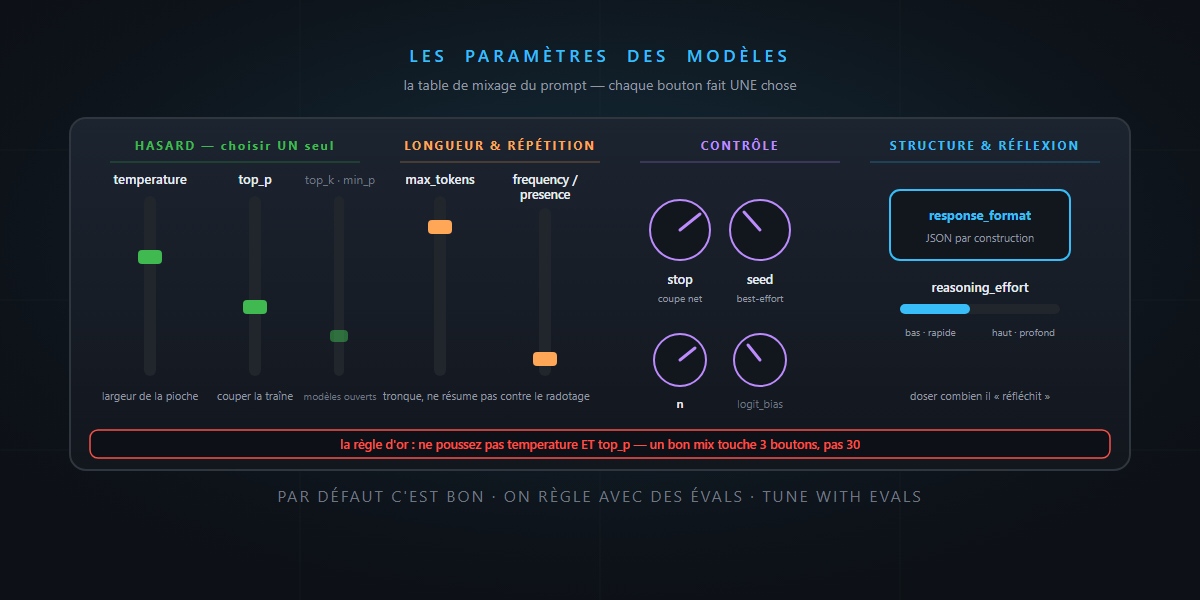
Today’s image: a mixing console. You’re the sound engineer, each fader and dial has a role, and the skill is knowing which to push for the effect you want, not pushing them all to the max. Let’s walk the console, group by group. You’ll see: it’s not rocket science.
The “randomness” group: temperature and top_p
The two best-known faders — and the most misused. They dose the randomness in the choice of each word (the actual mechanics of softmax, nucleus and friends are a specialists’ affair; today we stay practical):
temperature: the width of the draw. Low (→ 0), the model almost always takes the most probable word: sober, repetitive, reliable. High (→ 1 or 2 depending on the provider), it dares improbable choices (creative, diverse, adventurous). It’s the knob the hallucinations article will come back to in a few days.top_p(nucleus): instead of dosing randomness, it cuts the tail of unlikely words: “keep only the candidates weighing p%”. At 0.1, ultra-restrictive; at 1, anything goes.
The golden rule nobody states: don’t push both at once. They act on the same distribution, and combining them makes behavior unpredictable. Pick one: temperature for most cases, top_p if you want to firmly bound the drift. Leave the other at its default.
(On open models, two cousins appear: top_k (“keep the k best candidates”) and min_p (“nothing below X% of the favorite”). Same family, finer tuning.)
Enough theory — turn the knobs yourself. The widget below runs the real sampling formula (softmax + nucleus top-p) on four toy distributions. Pick a scenario, adjust the sliders, and above all, the most telling trick: keep the same settings while switching scenarios. You’ll watch the same temperature flatten an open story while leaving an established fact perfectly intact.
The “length” group: max_tokens
A single fader, but a classic trap. max_tokens (sometimes max_completion_tokens) caps the length of the response: output tokens, the most expensive. Two things you absolutely must know:
- It truncates, it doesn’t summarize. Hitting the limit cuts the response mid-sentence — it’s not “be shorter”, it’s “stop dead”. For shorter, ask in the prompt; the parameter is a seatbelt, not a style instruction.
- Reasoning models count their thinking in it. On those models, the invisible “thinking” tokens consume the budget before the visible answer even starts. Cap too low, and you get… nothing. Budget generously.
The “repetition” group: frequency and presence
Two dials to fight the model that rambles, useful in long generation:
| Knob | What it penalizes | The effect |
|---|---|---|
frequency_penalty |
words already used often | breaks literal repetitions (“very very very”) |
presence_penalty |
words that already appeared (even once) | pushes toward new topics, more variety |
Typical values from -2 to 2. A slight positive (0.3–0.6) usually suffices; too high, the model forbids itself necessary words and gets weird. Leave at zero by default, touch only if you see the rambling.
The “control” group: stop, seed, n
The knobs that frame the output without touching the style:
stop(orstop_sequences): strings that cut generation as soon as they appear. Essential when you generate homemade structure (“stop at###”) or a single line in a dialogue.seed: a seed to attempt to reproduce an output. The important word is attempt: it’s never guaranteed across a fleet of GPUs. Useful in development to replay a case, not a promise of determinism.n: request several answers in one call, handy for picking the best or exploring variants (beware, it multiplies the output bill).logit_bias: force or ban specific words. Powerful, surgical, rarely needed — the expert’s knob.
The “structure & thinking” group
The most modern settings on the console:
response_format/ structured outputs: impose a JSON schema. It’s not a style setting but a contract that constrains generation: valid JSON by construction. The right reflex for anything feeding a screen or an import.- Reasoning effort (
reasoning_effortor a thinking budget depending on the provider): on reasoning models, dosing how much the model “thinks” before answering. Low = fast and cheap; high = slower but better on hard problems. It’s the same logic as choosing the right model, but for compute intensity.
The recipes: which setting for which use
The table to keep handy (a starting point, not a law):
| Use | temperature | The rest |
|---|---|---|
| Factual, extraction, classification | 0 – 0.3 | response_format if structured output |
| Code | 0 – 0.2 | large max_tokens (reasoning included) |
| Writing, rewriting | 0.6 – 0.8 | slight frequency_penalty if repetitive |
| Brainstorm, ideation | 0.9 – 1.2 | n > 1 to vary the angles |
| Chat / assistant | 0.5 – 0.7 | stop on the speaking turn |
The word of honesty
- Names and ranges vary by provider. OpenAI, Anthropic, open models don’t expose exactly the same knobs or bounds (temperature up to 2 for one, 1 for another;
stopvsstop_sequences…). Always check your provider’s docs: this guide gives the map, not the exact territory. - The defaults are good. In the vast majority of cases, touch only the temperature. Cargo-culting settings (“I copied top_p 0.92 from a tutorial”) does more harm than good.
- Tune with evals, not by feel. A parameter that’s “better” over three tries might be luck. Measure before carving.
In summary
- An API call is a mixing console: each knob does one thing, the art is touching few.
- Randomness:
temperatureortop_p, never both. Length:max_tokenstruncates (doesn’t summarize) and includes reasoning. - Repetition:
frequency/presence_penaltyagainst rambling, dose lightly. Control:stop,seed(best-effort),n,logit_bias. - Structure:
response_formatfor guaranteed JSON; reasoning effort to dose the thinking. - And above all: defaults are fine, names vary by provider, and you tune with evals.
The console has many knobs, but a good mix pushes three, not thirty. Start with temperature, add a fader when a precise need calls for it, and measure. And that, honestly… is not rocket science.