ChatGPT, Claude, Gemini, Copilot… behind all those names hides the same beast: an LLM, for Large Language Model. We use one every day, we trust it with code, emails, decisions. But deep down, what is it? A knowledge base? A brain? Magic?
Good news: the core idea fits in one sentence, and once you get it, everything else (the hallucinations, the price, the limits) becomes obvious. You’ll see: it’s not rocket science.
The image to keep in mind: a giant autocomplete
You know the next-word suggestion on your phone keyboard? You type “I’m heading back ho…” and it offers “home”. It understands nothing: it has simply seen millions of sentences and knows which word often comes next.
An LLM is exactly that — but one that has read almost everything humanity has ever written. Books, code, forums, articles. At that scale, guessing “the next word” stops being a gimmick and starts to look like intelligence.
That’s the whole idea. The rest is detail, and the details are fascinating.
Deep down, what does it do? It guesses the next token
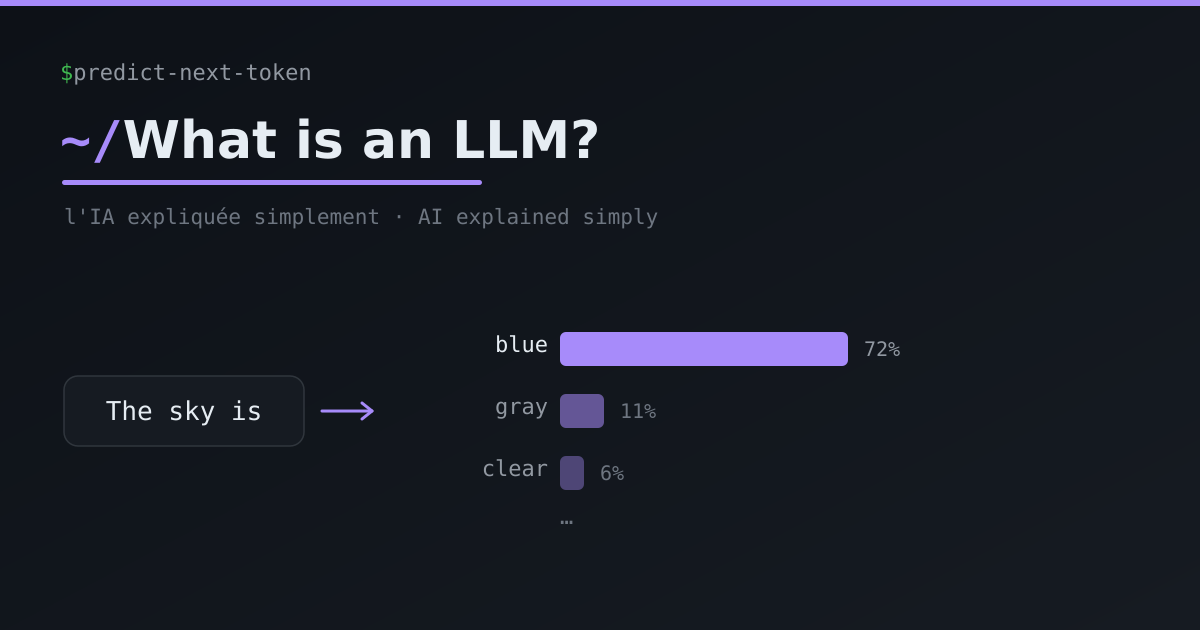
Give a model this beginning: “The sky is”. It won’t “look up” the answer in a database. It computes, for every possible word, a probability of being next:
The sky is →   blue    (72%)
               gray    (11%)
               clear    (6%)
               …
It picks one (often the most likely), appends the word, and starts over with “The sky is blue”, then again, word after word (or more precisely token after token). That’s next-token prediction.
Remember this, because everything follows from it: an LLM doesn’t recite facts, it computes the most plausible text. Most of the time, plausible = correct. Sometimes, not. We’ll get back to that.
How did it “learn”? Training
An LLM is a neural network: a very large program filled with billions of tiny internal settings, called parameters (or weights).
During training, it’s shown colossal amounts of text and made to play, over and over, a fill-in-the-blank game: “The cat drinks ___”. On every mistake, its billions of settings are nudged ever so slightly so it’s a little less wrong next time. Repeat billions of times, and it ends up “internalizing” grammar, facts, styles, reasoning.
Two essential things to understand:
- It doesn’t store the texts like a library. It keeps a kind of diffuse statistical intuition spread across its parameters. That’s why it can write brand-new sentences, but also why it doesn’t “know” anything precisely, word for word.
- Training ≠ using. Training is a one-off, long, wildly expensive phase (months, millions). After that, every time you talk to it is inference: you’re just running the already-trained model. It doesn’t learn from your conversation.
Why it’s stunning… and why it gets things wrong
At scale, capabilities emerge: translating, summarizing, coding, reasoning step by step. Nobody programmed them explicitly: they appeared while learning to predict text. That’s what makes LLMs so versatile.
But the same mechanism explains their flaws:
- Hallucinations. Since it produces plausible text, not verified text, an LLM can invent a quote, a function, a date — with total confidence. It’s not lying: it’s simply the most probable word.
- Frozen knowledge. It only knows what it saw during training (its cutoff date). Without a tool to fetch fresh information, it’s unaware of anything that happened since.
- No real fact base. By default it has “neither Google nor a calculator”, just its intuitions. Hence the value of giving it the context (see RAG) rather than relying on its memory.
What this changes for you, concretely
Seeing the LLM as a probabilistic text engine, not an oracle, instantly changes how you use it:
- Be specific. The model completes what you give it: a clear, contextualized prompt produces a far better continuation.
- Give it the facts. For a reliable answer about your data, provide it in the context rather than hoping it “knows” it.
- Verify what matters. For a fact, a number, a critical piece of code: check it. Plausible isn’t the same as true.
- Pick the right dial. Need creativity or rigor? That’s what temperature is for.
The LLM in 5 ideas
| Idea | In plain words |
|---|---|
| What it does | Guesses the next token, over and over: a giant autocomplete |
| How it learned | By tuning billions of parameters on enormous texts (training) |
| What it keeps | A statistical intuition, not an exact fact base |
| Why it errs | It produces plausible, not verified → hallucinations |
| How to use it well | Be specific, provide context, verify what matters |
In a nutshell
An LLM is neither a brain, nor an encyclopedia, nor magic: it’s an extraordinarily gifted autocomplete, trained to guess how a text continues. All the genius — and all the traps — comes from that.
Keep that image in mind, and AI stops being an intimidating black box. Because, deep down… it’s not rocket science.
A word you don’t know? The glossary defines every AI term, in plain language.